Sketchbook — Blog — Emma Block Illustration

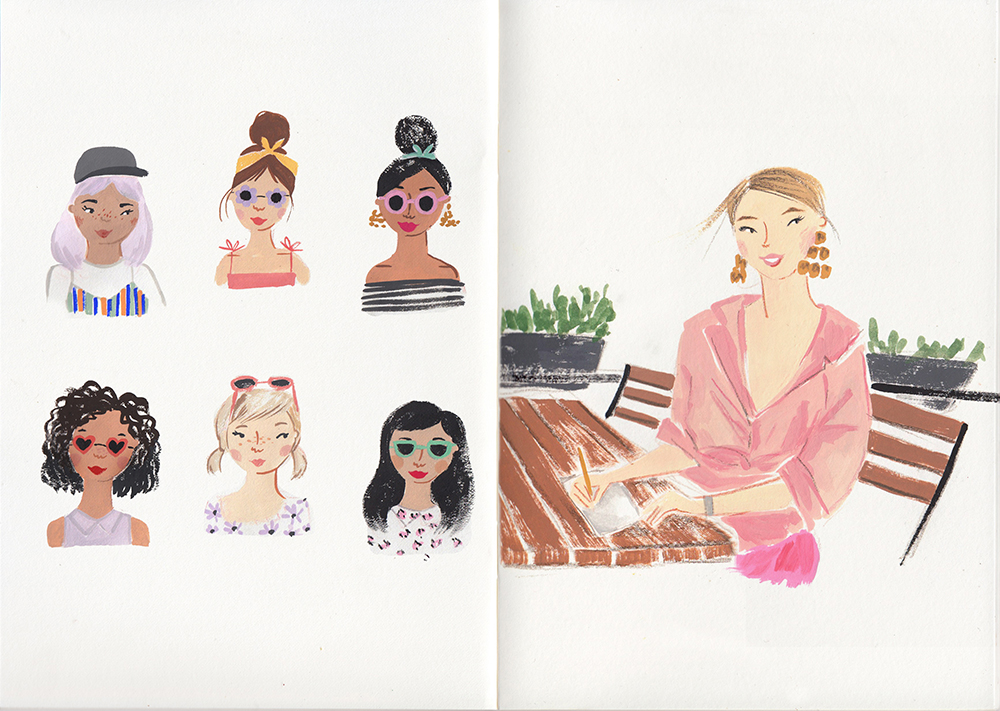
The blank page. It can be a source of immense possibility or crippling fear, can't it? The weight of potential, the pressure to create something meaningful, something beautiful, something… *good*. We've all been there, staring at that pristine, untouched surface, the cursor blinking mockingly on the screen, or the lead of the pencil poised uncertainly above the paper.
But what if we shifted our perspective? What if we stopped viewing the blank page as a test, and started seeing it as a playground? A space for experimentation, for exploration, for uninhibited expression. A place where mistakes are not failures, but opportunities for discovery.
That's what a sketchbook offers. It's more than just a collection of paper bound together. It's a laboratory for your creativity, a diary of your artistic journey, a tangible record of your thoughts and observations. It's a safe haven where you can let your imagination run wild without the fear of judgement, without the pressure to produce a masterpiece.
For many artists, the sketchbook is an indispensable tool, a constant companion, a trusted confidante. It's where ideas are born, where techniques are honed, where personal styles are forged. It's a place to practice, to play, to push boundaries, and to find your unique voice.
Today, we’re diving deep into the world of the sketchbook and how it relates to the work and inspiration found within Emma Block Illustration's creative journey. We’ll explore various aspects of using a sketchbook, the different approaches you can take, and the endless possibilities that await you within its pages. So, grab your favorite sketchbook, your preferred drawing tools, and let's get started on a journey of creative exploration with **sketchbook — Blog — Emma Block Illustration** as our guide.
The Sketchbook as a Creative Companion
The Sketchbook as a Safe Space
The beauty of a sketchbook lies in its inherent lack of pressure. Unlike a finished piece of art, your sketchbook entries are meant to be exploratory. It's a place where you can experiment with different mediums, try out new techniques, and explore various subjects without the fear of failure. This freedom allows you to take risks and push your creative boundaries in ways you might not otherwise consider.
Think of your sketchbook as your personal creative laboratory. It's a space where you can test out hypotheses, analyze your results, and refine your approach. It's a place where mistakes are not something to be avoided, but rather valuable learning opportunities that can lead to unexpected discoveries.
Furthermore, the sketchbook can serve as a private sanctuary, a place where you can express your thoughts and feelings without censorship or judgment. It's a place where you can be completely honest with yourself, and explore your inner world through the language of art.
Consider the difference between creating a piece intended for public consumption versus a sketch just for you. The former often comes with expectations and anxieties, while the latter is free from those constraints. That freedom is incredibly valuable for fostering creativity and allowing you to truly connect with your artistic voice.
Embrace the imperfections, the scribbles, the messy pages. These are all part of the process, and they contribute to the unique character of your sketchbook. Let go of the need for perfection and allow yourself to simply play and explore.
Documenting Daily Life Through Sketching
A sketchbook can be much more than just a repository for artistic experiments; it can also serve as a visual diary, a record of your daily life and experiences. By sketching your surroundings, you train yourself to observe the world with greater attention and detail.
Think about the everyday moments that often go unnoticed: the way the light falls on a building, the expression on a stranger's face, the arrangement of objects on your desk. Sketching these details allows you to capture the fleeting beauty of the ordinary and preserve it in a tangible form.
Furthermore, sketching on location can be a deeply immersive experience. It forces you to slow down, to observe, and to truly connect with your environment. You become more aware of the sights, sounds, and smells around you, and you gain a deeper appreciation for the world.
Carrying a small sketchbook with you wherever you go allows you to capture these moments as they happen. You can sketch on your commute, during your lunch break, or while waiting in line. Even a few minutes of sketching each day can add up to a rich and rewarding visual record of your life.
Don't worry about creating perfect renderings. The goal is simply to capture the essence of what you see, to record your observations, and to create a personal record of your experiences. These sketches will become treasured memories, reminding you of the moments you might otherwise have forgotten.
Finding Inspiration in Unexpected Places
Inspiration can strike at any time, in any place. A sketchbook provides a convenient way to capture these fleeting moments of inspiration and develop them further. Whether it's a striking color combination, a fascinating texture, or a compelling composition, your sketchbook can serve as a repository for all the things that spark your creativity.
Keep your sketchbook with you when you visit museums, art galleries, or even just go for a walk in nature. Observe the world around you with a keen eye, and jot down any ideas, images, or observations that resonate with you.
Don't be afraid to experiment with different mediums and techniques. Try sketching with pencils, pens, watercolors, or even collage. The more you experiment, the more likely you are to discover new and exciting ways to express your creativity.
Sometimes, the most unexpected sources can provide the greatest inspiration. A discarded piece of trash, a crack in the sidewalk, or a random pattern on a wall can all serve as catalysts for new ideas. Train yourself to see the beauty in the mundane, and you'll find that inspiration is all around you.
Refer back to your sketchbook regularly, and revisit the ideas and images you've collected. You might be surprised at how they evolve and develop over time. Your sketchbook can be a constant source of inspiration, helping you to generate new ideas and push your creative boundaries.
Sketchbook Techniques and Approaches
The Art of Quick Sketching
Quick sketching is an invaluable skill for any artist. It allows you to capture the essence of a subject quickly and efficiently, without getting bogged down in details. This is particularly useful when sketching on location, where time and conditions may be limited.
The key to quick sketching is to focus on the essential elements of the subject. Pay attention to the overall shape, the main lines, and the key proportions. Don't worry about rendering every detail perfectly; instead, focus on capturing the overall impression.
Practice sketching quickly by setting a timer and challenging yourself to capture a subject in a limited amount of time. Start with longer time intervals and gradually reduce the time as you become more proficient. This will help you to develop your speed and accuracy.
Use a variety of techniques to create quick sketches, such as gesture drawing, contour drawing, and blind contour drawing. These techniques will help you to focus on the essential elements of the subject and capture its essence quickly and effectively.
Don't be afraid to make mistakes. Quick sketching is all about capturing the overall impression, not creating a perfect rendering. Embrace the imperfections and allow yourself to experiment and explore.
Exploring Different Mediums in Your Sketchbook
Your sketchbook is the perfect place to experiment with different mediums and techniques. Trying out new materials can help you to discover new ways of expressing yourself and broaden your artistic horizons. Don't limit yourself to just pencils and pens; explore the possibilities of watercolors, inks, charcoal, pastels, and even mixed media.
Watercolors are a versatile medium that can be used to create a wide range of effects, from delicate washes to bold, vibrant colors. Experiment with different watercolor techniques, such as wet-on-wet, dry brush, and layering, to see what you can achieve.
Inks are another great option for sketchbook work. They can be used to create crisp, clean lines, as well as rich, textured washes. Experiment with different types of inks, such as fountain pen ink, India ink, and acrylic ink, to find the ones that you prefer.
Charcoal and pastels are excellent mediums for creating expressive drawings with rich tones and textures. Experiment with different types of charcoal and pastels, such as vine charcoal, compressed charcoal, and soft pastels, to see what you can achieve.
Don't be afraid to combine different mediums in your sketchbook. Mixed media can add depth, texture, and visual interest to your drawings. Experiment with collage, layering, and other techniques to create unique and expressive artwork.
Themed Sketchbook Projects
One way to add structure and focus to your sketchbook practice is to embark on themed sketchbook projects. This involves dedicating your sketchbook (or a section of it) to exploring a particular subject, theme, or technique. This can help you to develop your skills, deepen your understanding of a particular topic, and generate new ideas.
Choose a theme that interests you, such as flowers, trees, portraits, or buildings. Alternatively, you could focus on a particular technique, such as watercolor painting, pen and ink drawing, or collage.
Set yourself a goal for your themed sketchbook project. This could be to create a certain number of sketches, to explore a particular aspect of the theme, or to develop a particular skill.
Work on your themed sketchbook project regularly, and try to approach it with a sense of curiosity and experimentation. Don't be afraid to try new things and push your creative boundaries.
Review your themed sketchbook project regularly, and reflect on what you've learned. This will help you to identify your strengths and weaknesses, and to develop your skills further.
Overcoming Creative Blocks with Your Sketchbook
Embracing Imperfection and Letting Go of Expectations
One of the biggest obstacles to creative flow is the fear of making mistakes. We often put so much pressure on ourselves to create perfect artwork that we become paralyzed by anxiety. The sketchbook offers a safe space to let go of these expectations and embrace imperfection.
Remind yourself that your sketchbook is not meant to be a gallery or a showcase for your best work. It's a place to experiment, to explore, and to learn. It's a place where mistakes are not failures, but rather valuable learning opportunities.
Allow yourself to make mistakes without judgment. Don't try to erase or cover them up. Instead, embrace them as part of the process and see what you can learn from them.
Focus on the process of creating, rather than the end result. Enjoy the act of drawing, painting, or experimenting with different mediums. Let go of the need to create something perfect, and simply allow yourself to express yourself freely.
The more you embrace imperfection, the more you'll free yourself from creative blocks and unlock your full potential. Remember that even the most accomplished artists make mistakes. It's how you learn from those mistakes that matters.
Using Prompts and Exercises to Spark Creativity
When you're feeling creatively blocked, prompts and exercises can be a great way to jumpstart your imagination. Prompts can provide a starting point for your sketches, while exercises can help you to develop your skills and explore new techniques.
There are countless prompts available online and in books. These can range from simple prompts, such as "draw your favorite animal," to more complex prompts, such as "create a surreal landscape." Choose prompts that interest you and that challenge you to think outside the box.
Exercises can also be a valuable tool for overcoming creative blocks. Try exercises such as gesture drawing, contour drawing, blind contour drawing, or value studies. These exercises can help you to improve your observation skills, your hand-eye coordination, and your understanding of form and composition.
Don't be afraid to modify or adapt prompts and exercises to suit your own needs and interests. The goal is to find something that sparks your creativity and helps you to overcome your creative block.
Even just doodling aimlessly can sometimes trigger new ideas. Let your hand wander across the page, without any specific intention, and see what emerges. You might be surprised at what you discover.
Breaking Down Large Tasks into Smaller, Manageable Steps
Sometimes, creative blocks can arise from feeling overwhelmed by a large project. The sheer scope of the task can feel daunting, making it difficult to even begin. In these situations, it's helpful to break down the large task into smaller, more manageable steps.
Identify the individual components of the project and list them out. Then, focus on completing one small step at a time. This will make the overall task feel less overwhelming and more achievable.
Set realistic goals for yourself. Don't try to accomplish too much at once. Instead, focus on making small, incremental progress each day.
Reward yourself for completing each step. This will help to keep you motivated and on track.
Remember that progress is not always linear. There will be times when you feel stuck or when you take a step backwards. Don't get discouraged. Just keep moving forward, one step at a time.
Sketchbook as a Tool for Visual Thinking
Developing Ideas and Problem-Solving Visually
The sketchbook isn't just a repository for finished artwork; it's a powerful tool for visual thinking and problem-solving. Using sketches, diagrams, and visual notes, you can explore complex ideas, brainstorm solutions, and develop your creative concepts.
When faced with a challenge or a problem, try sketching out different possible solutions. Don't worry about creating perfect drawings; the goal is simply to visualize your ideas and explore different options.
Use diagrams and flowcharts to map out processes, relationships, and systems. This can help you to understand complex information more clearly and identify potential bottlenecks or areas for improvement.
Take visual notes during meetings, lectures, or brainstorming sessions. Instead of just writing down words, try sketching out key ideas, concepts, and connections. This will help you to remember the information more effectively and to engage with it on a deeper level.
Sketching can also be a valuable tool for planning and organizing your projects. Use sketches to map out your timelines, your resources, and your workflow. This can help you to stay on track and to manage your time more effectively.
Mind Mapping and Brainstorming in Your Sketchbook
Mind mapping is a powerful technique for brainstorming and generating new ideas. It involves starting with a central idea and then branching out with related concepts, keywords, and images. Your sketchbook is the perfect place to create mind maps and explore your ideas visually.
Start by writing your central idea in the middle of a page. Then, draw branches radiating outwards from the central idea, and write down related concepts, keywords, and images on each branch.
Use different colors, fonts, and symbols to differentiate between different branches and to add visual interest to your mind map.
Don't be afraid to let your mind wander and to explore unexpected connections. The goal of mind mapping is to generate as many ideas as possible, without judgment or censorship.
Review your mind maps regularly, and look for patterns, connections, and insights. This can help you to develop your ideas further and to generate new solutions to your problems.
Sketching as a Form of Visual Note-Taking
Visual note-taking, also known as sketchnoting, is a powerful way to capture information and ideas in a more engaging and memorable way. Instead of just writing down words, you combine text, images, symbols, and layouts to create a visual record of what you're learning.
Choose a simple and consistent style for your visual notes. This will make them easier to read and understand.
Use a variety of visual elements, such as boxes, arrows, circles, and lines, to organize your notes and to highlight key information.
Incorporate images, symbols, and icons to represent key concepts and ideas. This will make your notes more visually appealing and easier to remember.
Don't worry about creating perfect drawings. The goal is simply to capture the essence of the information in a visual form. Focus on clarity and conciseness, rather than artistic perfection.
Visual note-taking can be used in a variety of settings, such as meetings, lectures, workshops, and conferences. It's a great way to stay engaged, to capture key information, and to remember what you've learned.
The Digital Sketchbook: Blending Tradition and Technology
Exploring Digital Sketching Apps and Software
While the traditional paper sketchbook holds a special place in many artists' hearts, digital sketching apps and software offer a range of benefits and possibilities. They provide access to a vast array of tools and effects, allowing for experimentation and refinement that might not be possible with traditional mediums.
There are numerous digital sketching apps available for tablets and smartphones, each with its own unique features and strengths. Some popular options include Procreate, Adobe Fresco, and Sketchbook. These apps offer a variety of brushes, pencils, pens, and other tools, as well as features like layers, blend modes, and color palettes.
For artists who prefer to work on a desktop or laptop, there are also several excellent digital sketching software programs available, such as Adobe Photoshop, Corel Painter, and Clip Studio Paint. These programs offer even more advanced features and capabilities, allowing for highly detailed and complex artwork.
Experiment with different digital sketching apps and software to find the ones that best suit your needs and preferences. Consider factors such as the user interface, the available tools, the performance, and the price.
Don't be afraid to combine traditional and digital techniques. You can scan your paper sketches and then refine them digitally, or you can create digital sketches and then print them out and add traditional embellishments.
Advantages of Digital Sketching: Undo, Layers, and Portability
Digital sketching offers several advantages over traditional sketching, including the ability to undo mistakes, work with layers, and carry your entire sketchbook with you wherever you go. These features can significantly enhance your workflow and allow for greater creative freedom.
The undo function is a lifesaver for digital artists. If you make a mistake, you can simply undo it and try again. This eliminates the fear of ruining your artwork and allows you to experiment more freely.
Layers allow you to work on different elements of your artwork separately, without affecting the other elements. This makes it easy to make changes, adjustments, and refinements without having to start from scratch.
Digital sketchbooks are incredibly portable. You can store hundreds or even thousands of sketches on your tablet or smartphone and access them anytime, anywhere. This makes it easy to sketch on the go, whether you're traveling, waiting in line, or simply relaxing at home.
Another advantage of digital sketching is the ability to easily share your artwork with others. You can quickly email your sketches, post them on social media, or print them out.
Integrating Digital and Traditional Sketchbook Practices
There's no need to choose between traditional and digital sketchbook practices. In fact, many artists find that integrating the two can lead to even more creative and rewarding experiences. By combining the tactile feel of paper and pencil with the flexibility and versatility of digital tools, you can create a truly unique and personal workflow.
One way to integrate digital and traditional practices is to scan your paper sketches and then refine them digitally. This allows you to preserve the spontaneity and authenticity of your traditional sketches while taking advantage of the digital tools for editing, enhancing, and coloring.
Another approach is to create digital sketches and then print them out and add traditional embellishments. This allows you to combine the precision and control of digital sketching with the textures and nuances of traditional mediums.
You can also use digital sketching apps to create thumbnails and preliminary sketches for larger, more complex traditional artwork. This allows you to experiment with different compositions, colors, and values before committing to a final piece.
Ultimately, the best way to integrate digital and traditional sketchbook practices is to experiment and find what works best for you. Don't be afraid to try new things and to combine different techniques. The goal is to create a workflow that is both efficient and enjoyable.
Sharing Your Sketchbook: Building Community and Inspiration
The Benefits of Sharing Your Work Online
Sharing your sketchbook work online can be a powerful way to connect with other artists, receive feedback, and build your audience. Platforms like Instagram, DeviantArt, and online art communities provide a space to showcase your work, engage with others, and find inspiration.
One of the biggest benefits of sharing your work online is the opportunity to receive feedback from other artists. Constructive criticism can help you to identify areas for improvement and to develop your skills further.
Sharing your work online can also help you to build your audience and connect with potential clients or collaborators. By showcasing your work, you can attract attention from people who appreciate your style and who might be interested in commissioning your artwork.
Seeing the work of other artists can be incredibly inspiring. Online art communities provide a constant stream of new ideas and techniques, which can help you to stay motivated and to push your creative boundaries.
Sharing your sketchbook work online can also be a great way to document your artistic journey and to track your progress over time.
Building a Supportive Online Art Community
Building a supportive online art community can be incredibly beneficial for your creative growth and well-being. By connecting with other artists who share your interests and values, you can create a space where you feel encouraged, supported, and inspired.
Start by engaging with other artists' work. Leave thoughtful comments, ask questions, and offer encouragement. This will help you to build relationships and to create a sense of community.
Share your own work regularly and be open to receiving feedback. Don't be afraid to ask for help or advice when you need it.
Participate in online art challenges and events. This is a great way to connect with other artists and to push your creative boundaries.
Be respectful and supportive of other artists, even if you don't always agree with their opinions. Remember that everyone is on their own creative journey, and everyone deserves to be treated with kindness and respect.
Remember **sketchbook — Blog — Emma Block Illustration** is an amazing resource for inspiration.
Navigating Criticism and Staying True to Your Vision
Receiving criticism is an inevitable part of being an artist. While constructive criticism can be helpful for improving your skills, it's important to learn how to navigate criticism and to stay true to your artistic vision.
When receiving criticism, try to separate the personal from the professional. Remember that the person is criticizing your artwork, not you as a person.
Listen carefully to what the person is saying and try to understand their perspective. Ask clarifying questions if you're unsure of what they mean.
Consider whether the criticism is valid and whether it aligns with your own artistic goals. If it is, then use it as an opportunity to learn and grow. If it isn't, then feel free to disregard it.
Ultimately, the most important thing is to stay true to your artistic vision. Don't let criticism deter you from pursuing your own unique style and ideas. Remember **sketchbook — Blog — Emma Block Illustration** is all about staying true to your vision
Surround yourself with supportive people who believe in your potential and who encourage you to pursue your dreams.
Conclusion: Embrace the Journey of Sketchbooking
So, there you have it – a deep dive into the wonderfully versatile world of sketchbooks. From acting as a safe space for creative exploration to serving as a tool for visual thinking and problem-solving, the sketchbook is an invaluable resource for any artist, designer, or creative individual.
Remember, the key is to embrace the journey of sketchbooking, to let go of perfectionism, and to allow yourself to experiment, explore, and have fun. Whether you prefer traditional paper sketchbooks or digital sketching apps, the most important thing is to develop a practice that works for you and that helps you to unlock your full creative potential.
Don't be afraid to share your sketchbook work with others and to connect with online art communities. Receiving feedback and finding inspiration from other artists can be incredibly beneficial for your growth and well-being.
And remember, there's always more to learn and explore. Don't stop experimenting with different mediums, techniques, and approaches. The more you push your creative boundaries, the more you'll discover about yourself and your artistic potential.
If you enjoyed this article, be sure to check out other articles on the blog for more tips, inspiration, and resources for artists and creatives. Happy sketching!
- The blank page. It can be a source of immense possibility or crippling fear, can't it?
- The weight of potential, the pressure to create something meaningful, something beautiful, something… good.
- We've all been there, staring at that pristine, untouched surface, the cursor blinking mockingly on the screen, or the lead of the pencil poised uncertainly above the paper.
- But what if we shifted our perspective? What if we stopped viewing the blank page as a test, and started seeing it as a playground?
- A space for experimentation, for exploration, for uninhibited expression.
- A place where mistakes are not failures, but opportunities for discovery.
- That's what a sketchbook offers. It's more than just a collection of paper bound together.
- It's a laboratory for your creativity, a diary of your artistic journey, a tangible record of your thoughts and observations.
- It's a safe haven where you can let your imagination run wild without the fear of judgement, without the pressure to produce a masterpiece.
- For many artists, the sketchbook is an indispensable tool, a constant companion, a trusted confidante.
- It's where ideas are born, where techniques are honed, where personal styles are forged.
- It's a place to practice, to play, to push boundaries, and to find your unique voice.
- Today, we’re diving deep into the world of the sketchbook and how it relates to the work and inspiration found within Emma Block Illustration's creative journey.
- We’ll explore various aspects of using a sketchbook, the different approaches you can take, and the endless possibilities that await you within its pages.
- So, grab your favorite sketchbook, your preferred drawing tools, and let's get started on a journey of creative exploration with sketchbook — Blog — Emma Block Illustration as our guide.
- The beauty of a sketchbook lies in its inherent lack of pressure.
- Unlike a finished piece of art, your sketchbook entries are meant to be exploratory.
- It's a place where you can experiment with different mediums, try out new techniques, and explore various subjects without the fear of failure.
- This freedom allows you to take risks and push your creative boundaries in ways you might not otherwise consider.
- Think of your sketchbook as your personal creative laboratory.
- It's a space where you can test out hypotheses, analyze your results, and refine your approach.
- It's a place where mistakes are not something to be avoided, but rather valuable learning opportunities that can lead to unexpected discoveries.
- Furthermore, the sketchbook can serve as a private sanctuary, a place where you can express your thoughts and feelings without censorship or judgment.
- It's a place where you can be completely honest with yourself, and explore your inner world through the language of art.
- Consider the difference between creating a piece intended for public consumption versus a sketch just for you.
- The former often comes with expectations and anxieties, while the latter is free from those constraints.
- That freedom is incredibly valuable for fostering creativity and allowing you to truly connect with your artistic voice.
- Embrace the imperfections, the scribbles, the messy pages.
- These are all part of the process, and they contribute to the unique character of your sketchbook.
- Let go of the need for perfection and allow yourself to simply play and explore.
- A sketchbook can be much more than just a repository for artistic experiments; it can also serve as a visual diary, a record of your daily life and experiences.
- By sketching your surroundings, you train yourself to observe the world with greater attention and detail.
- Think about the everyday moments that often go unnoticed: the way the light falls on a building, the expression on a stranger's face, the arrangement of objects on your desk.
- Sketching these details allows you to capture the fleeting beauty of the ordinary and preserve it in a tangible form.
- Furthermore, sketching on location can be a deeply immersive experience.
- It forces you to slow down, to observe, and to truly connect with your environment.
- You become more aware of the sights, sounds, and smells around you, and you gain a deeper appreciation for the world.
- Carrying a small sketchbook with you wherever you go allows you to capture these moments as they happen.
- You can sketch on your commute, during your lunch break, or while waiting in line.
- Even a few minutes of sketching each day can add up to a rich and rewarding visual record of your life.
- Don't worry about creating perfect renderings.
- The goal is simply to capture the essence of what you see, to record your observations, and to create a personal record of your experiences.
- These sketches will become treasured memories, reminding you of the moments you might otherwise have forgotten.
- Inspiration can strike at any time, in any place.
- A sketchbook provides a convenient way to capture these fleeting moments of inspiration and develop them further.
- Whether it's a striking color combination, a fascinating texture, or a compelling composition, your sketchbook can serve as a repository for all the things that spark your creativity.
- Keep your sketchbook with you when you visit museums, art galleries, or even just go for a walk in nature.
- Observe the world around you with a keen eye, and jot down any ideas, images, or observations that resonate with you.
- Don't be afraid to experiment with different mediums and techniques.
- Try sketching with pencils, pens, watercolors, or even collage.
- The more you experiment, the more likely you are to discover new and exciting ways to express your creativity.
- Sometimes, the most unexpected sources can provide the greatest inspiration.
- A discarded piece of trash, a crack in the sidewalk, or a random pattern on a wall can all serve as catalysts for new ideas.
- Train yourself to see the beauty in the mundane, and you'll find that inspiration is all around you.
- Refer back to your sketchbook regularly, and revisit the ideas and images you've collected.
- You might be surprised at how they evolve and develop over time.
- Your sketchbook can be a constant source of inspiration, helping you to generate new ideas and push your creative boundaries.
- Quick sketching is an invaluable skill for any artist.
- It allows you to capture the essence of a subject quickly and efficiently, without getting bogged down in details.
- This is particularly useful when sketching on location, where time and conditions may be limited.
- The key to quick sketching is to focus on the essential elements of the subject.
- Pay attention to the overall shape, the main lines, and the key proportions.
- Don't worry about rendering every detail perfectly; instead, focus on capturing the overall impression.
- Practice sketching quickly by setting a timer and challenging yourself to capture a subject in a limited amount of time.
- Start with longer time intervals and gradually reduce the time as you become more proficient.
- This will help you to develop your speed and accuracy.
- Use a variety of techniques to create quick sketches, such as gesture drawing, contour drawing, and blind contour drawing.
- These techniques will help you to focus on the essential elements of the subject and capture its essence quickly and effectively.
- Don't be afraid to make mistakes.
- Quick sketching is all about capturing the overall impression, not creating a perfect rendering.
- Embrace the imperfections and allow yourself to experiment and explore.
- Your sketchbook is the perfect place to experiment with different mediums and techniques.
- Trying out new materials can help you to discover new ways of expressing yourself and broaden your artistic horizons.
- Don't limit yourself to just pencils and pens; explore the possibilities of watercolors, inks, charcoal, pastels, and even mixed media.
- Watercolors are a versatile medium that can be used to create a wide range of effects, from delicate washes to bold, vibrant colors.
- Experiment with different watercolor techniques, such as wet-on-wet, dry brush, and layering, to see what you can achieve.
- Inks are another great option for sketchbook work.
- They can be used to create crisp, clean lines, as well as rich, textured washes.
- Experiment with different types of inks, such as fountain pen ink, India ink, and acrylic ink, to find the ones that you prefer.
- Charcoal and pastels are excellent mediums for creating expressive drawings with rich tones and textures.
- Experiment with different types of charcoal and pastels, such as vine charcoal, compressed charcoal, and soft pastels, to see what you can achieve.
- Don't be afraid to combine different mediums in your sketchbook.
- Mixed media can add depth, texture, and visual interest to your drawings.
- Experiment with collage, layering, and other techniques to create unique and expressive artwork.
- One way to add structure and focus to your sketchbook practice is to embark on themed sketchbook projects.
- This involves dedicating your sketchbook (or a section of it) to exploring a particular subject, theme, or technique.
- This can help you to develop your skills, deepen your understanding of a particular topic, and generate new ideas.
- Choose a theme that interests you, such as flowers, trees, portraits, or buildings.
- Alternatively, you could focus on a particular technique, such as watercolor painting, pen and ink drawing, or collage.
- Set yourself a goal for your themed sketchbook project.
- This could be to create a certain number of sketches, to explore a particular aspect of the theme, or to develop a particular skill.
- Work on your themed sketchbook project regularly, and try to approach it with a sense of curiosity and experimentation.
- Don't be afraid to try new things and push your creative boundaries.
- Review your themed sketchbook project regularly, and reflect on what you've learned.
- This will help you to identify your strengths and weaknesses, and to develop your skills further.
- One of the biggest obstacles to creative flow is the fear of making mistakes.
- We often put so much pressure on ourselves to create perfect artwork that we become paralyzed by anxiety.
- The sketchbook offers a safe space to let go of these expectations and embrace imperfection.
- Remind yourself that your sketchbook is not meant to be a gallery or a showcase for your best work.
- It's a place to experiment, to explore, and to learn.
- It's a place where mistakes are not failures, but rather valuable learning opportunities.
- Allow yourself to make mistakes without judgment.